There is one topic that should come before all others in the 2016 elections. This issue directly affects the lives of every single person currently living on planet Earth, as well as everyone who is born between now and the end of the world. Incredibly, the preceding statement is not even slightly hyperbolic. While there are undoubtedly many other important issues, no other issue affects the entire world to the extent that climate change does. Climate change is real, and we need a president (and congressional representatives) who is willing to take bold steps to mitigate the damage already done.
Climate scientists resoundingly agree: climate change is happening, and humans are the main driving force of it. NASA agrees. The Intergovernmental Panel on Climate Change (IPCC) agrees. The European Union Commission agrees. Business Insider agrees. The EPA agrees. And so do 97+ percent of climate scientists. Scientists' agreement on climate change is similar to their agreement that cigarettes can kill you. And for anyone who wants to cite one of the few scientists who deny that climate change is human-caused as evidence that it isn't real, you can also find scientists who will argue that gravity isn't real.
The effects of climate change will be far-reaching and swift. NASA has some good pages that show some of the effects (overview and US regional effects; sea level rise; images of change; and a "time machine") , as does The Nature Conservancy. Ice caps and glaciers will melt, which will lead to sea level rise, which could flood the homes of millions people worldwide. Weather patterns will change, with more extreme weather becoming more common. Events like Hurricane Katrina, superstorm Sandy, the flooding in South Carolina and now Texas, Hurricane Patricia, and the California drought will not be as large of outliers as they currently appear. Old agricultural techniques may become less effective.
Exacerbating the issue is the fact that climate change is disproportionately affecting the people who are in the least position to do anything about it, and who are also contributing to climate change the least. Poor people directly dependent on agriculture for their livelihood don't need to be told by scientists that climate change is real--they see it in action and have to adapt their lives because of it. The governments of influential nations (which are overwhelmingly industrialized and are large polluters) have a responsibility to their own people, as well as the people of other countries, to not poison the world we all live in.
This should not be a partisan issue. While I am sure conservatives and liberals will (and do) disagree about what is to be done about climate change, there should be consensus that it is real and human-caused, and that something must be done to slow or reverse it if possible. Why might a politician deny this, choose to ignore it, or fail to act on it? I can think of only three reasons: (1) Ignorance. If this is the case, it is unacceptable in a presidential candidate; the "leader of the free world" cannot afford to be ignorant on such an important issue. (2) They are corrupted by and sold out to big oil, coal, and gas companies. If this is the case, then the politician is willing to put the short-term profits of corporations (often run by old men who won't be around to see the worst of climate change but will see the short-term profits) over the long-term well-being of the world. (3) Someone who ran for president as a Democrat (Al Gore) was one of the first vocal advocates for climate accountability. If a politician is not willing to lead his or her party into consensus on a decided issue that affects everyone in the world, they should not be president. Being wrong on climate change is not something anyone should hold their ground on. Partisan politics should have nothing to do with climate change. Whatever the reason for a candidate's refusal to act on climate change, he or she is unfit for the Oval Office.
I cannot vote for a candidate who is either ignorant enough or corrupt enough to push policies that do not try to mitigate climate change, or worse, actively support actions and corporations that make it worse. The future of the world is not worth mortgaging for the short-term profits of fossil fuel companies, a few thousand jobs, or even short-term economic health and growth. As candidates on both sides of the 2016 presidential race like to remind us, America must be a global leader, and the world can't handle 4 years of a climate-blind America.
Some useful links about climate change, its effects, and what is being done to combat it:
UNICEF Climate Change Report
1o5C (group to try to keep temperature rise below 1.5 degrees Celsius)
Food Security in the Pacific
Pole to Paris (awareness group)
Empowering the Poor in a Changing Climate (UN Development Programme publication with 12 case studies of poor people who have adapted to climate changes)
Checklist of where 2016 presidential candidates stand on climate change (at bottom of article)
More thorough examination of candidates' stances on climate change (for some reason lacking Ben Carson--you'll have to go to his personal campaign page on the site)
EPA suggestions for limiting your carbon footprint
Canada's suggestions for limiting your carbon footprint
Friday, October 23, 2015

Thursday, October 15, 2015
Why Black Lives Matter
Black Lives Matter. People really need to stop saying "All Lives Matter." Why? Because white people don't need the value of their lives affirmed. White lives have always mattered in American politics and life, but the idea that black lives matter is a novel one. Bernie Sanders messed it up at the Netroots town-hall meeting earlier this summer, but redeemed himself and learned from his mistake in the first Democratic debate. Bernie got it, and his response in the debate was the right one. To understand why that response was the right one, and to understand why Black Lives Matter, it is imperative to understand the racial history of the United States.
Early white American settlers began using slaves long before there was such a thing as the "United States." Slavery made economic sense because you don't have to pay slaves, therefore increasing profits. Slavery was not a new idea, but the justification for it was new. Most other societies with slavery up to that point simply saw it as a power balance. People with power enslaved those without it. Americans, however, believed strongly in the ideas of freedom and human rights, ideas with which slavery is incompatible. To reconcile slavery with freedom, they (along with other Europeans) invented the idea of race--that there were different "races" of people with inherent differences between them. (While Wikipedia is not always the best source, the Wikipedia page on Scientific Racism has a good overview of this idea and the thinkers who propagated it.)
Indeed, before this idea took root, there were white slaves in America. In order to keep white and black slaves from working together to overthrow their masters, however, the lowly whites were appeased with the idea that they were better than their black counterparts. "Scientists" did experiments to investigate intelligence levels, temperaments, and many other traits, and their manufactured conclusions supported what they wanted them to support: the inferiority of non-whites. Many scientists made hierarchies, and inevitably the "race" the scientist belonged to would come out on top. British scientists would find British people to be the highest race, French scientists would find the French, and likewise for Germans, et cetera. It is clear from these "scientific" discoveries that the idea of race, and therefore the idea of blackness, is based on the belief that black lives, in fact, do not matter (and that white lives do).
Slavery was based on the idea that black lives do not matter. I am going to skip a large chunk of American history, to the period following the Civil War, when slavery was abolished. (The Civil War, by the way, was most assuredly about slavery. If you believe otherwise, please read the article linked on the right sidebar.) By the time slavery was formally ended in the United States, the idea of race had become completely ingrained in society. As Michelle Alexander puts it in her book, The New Jim Crow, "The history of racial caste in America would end with the Civil War if the idea of race and racial difference had died when the institution of slavery was put to rest.... Indeed, the notion of racial difference--specifically the notion of white supremacy--proved far more durable than the institution that gave birth to it." White people still largely believed the lies they had been told about race, and strove to find a new way keep the separation that slavery had created between whites and blacks.
The new system became known as "Jim Crow." In this system, many states passed laws (examples here, here, and here) that attempted to return black Americans to as close to a state of slavery as they could manage. On top of this, the Ku Klux Klan terrorized black communities, lynching and threatening black people for simply attempting to live their lives. Black Americans were severely limited in their education, employment opportunities, civil liberties, and just about everything else. Jim Crow-era America was a strong continuation of the idea that Black Lives Do Not Matter. I could go on about the details and horrors of Jim Crow America, but there is unfortunately not enough room for it in a blog post. I would suggest reading the first chapter of The New Jim Crow, which does an excellent job of laying out the history of oppression. (Seriously, read it. The link to the Amazon page is above.)
White Americans love to believe that racism ended in America around the time of the Civil Rights movement in the 1960s. Unfortunately, that is neither realistic nor correct. Black Americans have had to endure racist housing policies that forced them to live in areas with low property value, robbing from them one of the major sources of wealth for white families: appreciating real estate values. This was part of a cycle that continues today: white families pass down property that increases the wealth of the next generation, while black families lose wealth through real estate. Housing discrimination ties directly into educational discrimination. In 1954, the Supreme Court ruled that "separate but equal" facilities were unconstitutional, leading to the (painfully slow) integration of America's schools. Unfortunately, soon after the integration of schools, white Americans fled to the suburbs, effectively re-segregating the schools. Because black families were not allowed housing in many suburban neighborhoods, even well-off black families could not move to districts that were better-financed (quality of education has nothing to do with the color of students' skin, but it has everything to do with the property values of homes in the school district). Discriminatory housing policies directly led to a vast educational gap, which further exacerbates economic inequality.
In addition to these discriminatory policies, the new War on Drugs was both explicitly and implicitly racist. In the post-Civil Rights era, it was no longer politically viable to use explicitly racist language, but white politicians found a way around this. The War on Drugs used language that was hard to argue against (safe streets, protecting children, tough on crime) to validate awful policies. Young black men began to be arrested far out of proportion for nonviolent drug offenses. Laws dictating minimum sentences were disproportionate for crack cocaine versus powder cocaine--the main difference between the two being that powder cocaine was more expensive and more often used by rich white people. Simply put, powder cocaine was the white person's cocaine, and crack was the black person's cocaine. (Obviously it is not this simple, but black users used crack at a higher rate than white users did, and vice versa for powder). It took 100 times as much powder cocaine by weight to carry the same minimum sentence as did crack. In addition, there was disproportionate police attention in poor, black neighborhoods. Even without gross sentencing disparities, police have been arresting black people at a rate completely disproportionate to other races from the inception of the drug war to the present day. Take, for example, marijuana use versus marijuana arrests:


The racism here is quite clear, and black people know it. Police disproportionately target black neighborhoods and people, whether white people want to admit it or not. While white kids are taught to trust the cops and that they are "good guys" and there to help, black kids, especially young boys, are given "the talk" (if you only watch one TED talk, let it be this one) about being careful around cops (and your friendly neighborhood vigilante) because they are dangerous. Black people, and specifically black men, are jailed at an unconscionable rate, continuing the idea that Black Lives Do Not Matter. Try to wrap your mind around this graph:

There has never been a break in the idea that Black Lives Do Not Matter. The idea of blackness was founded on it and continues to this day. The history of race is one long saga chronicling the mattering of white lives and the insignificance of black ones. Traditional histories tell us this, telling historical stories only through the eyes of powerful white men. Black kids hear this message loud and clear in history class as well as in real life. In the spring of 2015, I was student teaching in a diverse charter school. During a World History class, a freshman girl, who happened to be black, was looking through the textbook looking for a historical figure to learn about and write about. After a few minutes I walked over to her to see how she was doing, and she said to me, "Mr. H, there ain't no black people in this book." And it was true. In a textbook that claimed to chronicle the history of the whole world, there were barely more than a handful of black characters. White people utterly dominated the pages of the book, telling every black student who read it that they did not matter, and every white student that they did.
We need to say Black Lives Matter rather than All Lives Matter because black lives need to be affirmed. Young black kids have learned that most of the time when white people talk about how all lives matter they don't mean black lives. They've learned to tune out the lies and hypocrisy (but that doesn't mean it doesn't still hurt). They've learned that Black Lives Have Never Mattered. So no matter how genuine you are in your belief that all lives matter, say Black Lives Matter instead because the young black people in this country need to hear it. They need to see it in practice. You're not saying that non-black lives don't matter. You are affirming the lives of a long-mistreated group of valuable human beings and paving the way for a positive change toward actual equality. Stop saying All Lives Matter. White people don't need to hear it. Black Lives Matter.
Early white American settlers began using slaves long before there was such a thing as the "United States." Slavery made economic sense because you don't have to pay slaves, therefore increasing profits. Slavery was not a new idea, but the justification for it was new. Most other societies with slavery up to that point simply saw it as a power balance. People with power enslaved those without it. Americans, however, believed strongly in the ideas of freedom and human rights, ideas with which slavery is incompatible. To reconcile slavery with freedom, they (along with other Europeans) invented the idea of race--that there were different "races" of people with inherent differences between them. (While Wikipedia is not always the best source, the Wikipedia page on Scientific Racism has a good overview of this idea and the thinkers who propagated it.)
 |
| A diagram showing how Negroes fell somewhere between Greeks and chimpanzees |
Slavery was based on the idea that black lives do not matter. I am going to skip a large chunk of American history, to the period following the Civil War, when slavery was abolished. (The Civil War, by the way, was most assuredly about slavery. If you believe otherwise, please read the article linked on the right sidebar.) By the time slavery was formally ended in the United States, the idea of race had become completely ingrained in society. As Michelle Alexander puts it in her book, The New Jim Crow, "The history of racial caste in America would end with the Civil War if the idea of race and racial difference had died when the institution of slavery was put to rest.... Indeed, the notion of racial difference--specifically the notion of white supremacy--proved far more durable than the institution that gave birth to it." White people still largely believed the lies they had been told about race, and strove to find a new way keep the separation that slavery had created between whites and blacks.
The new system became known as "Jim Crow." In this system, many states passed laws (examples here, here, and here) that attempted to return black Americans to as close to a state of slavery as they could manage. On top of this, the Ku Klux Klan terrorized black communities, lynching and threatening black people for simply attempting to live their lives. Black Americans were severely limited in their education, employment opportunities, civil liberties, and just about everything else. Jim Crow-era America was a strong continuation of the idea that Black Lives Do Not Matter. I could go on about the details and horrors of Jim Crow America, but there is unfortunately not enough room for it in a blog post. I would suggest reading the first chapter of The New Jim Crow, which does an excellent job of laying out the history of oppression. (Seriously, read it. The link to the Amazon page is above.)
White Americans love to believe that racism ended in America around the time of the Civil Rights movement in the 1960s. Unfortunately, that is neither realistic nor correct. Black Americans have had to endure racist housing policies that forced them to live in areas with low property value, robbing from them one of the major sources of wealth for white families: appreciating real estate values. This was part of a cycle that continues today: white families pass down property that increases the wealth of the next generation, while black families lose wealth through real estate. Housing discrimination ties directly into educational discrimination. In 1954, the Supreme Court ruled that "separate but equal" facilities were unconstitutional, leading to the (painfully slow) integration of America's schools. Unfortunately, soon after the integration of schools, white Americans fled to the suburbs, effectively re-segregating the schools. Because black families were not allowed housing in many suburban neighborhoods, even well-off black families could not move to districts that were better-financed (quality of education has nothing to do with the color of students' skin, but it has everything to do with the property values of homes in the school district). Discriminatory housing policies directly led to a vast educational gap, which further exacerbates economic inequality.
In addition to these discriminatory policies, the new War on Drugs was both explicitly and implicitly racist. In the post-Civil Rights era, it was no longer politically viable to use explicitly racist language, but white politicians found a way around this. The War on Drugs used language that was hard to argue against (safe streets, protecting children, tough on crime) to validate awful policies. Young black men began to be arrested far out of proportion for nonviolent drug offenses. Laws dictating minimum sentences were disproportionate for crack cocaine versus powder cocaine--the main difference between the two being that powder cocaine was more expensive and more often used by rich white people. Simply put, powder cocaine was the white person's cocaine, and crack was the black person's cocaine. (Obviously it is not this simple, but black users used crack at a higher rate than white users did, and vice versa for powder). It took 100 times as much powder cocaine by weight to carry the same minimum sentence as did crack. In addition, there was disproportionate police attention in poor, black neighborhoods. Even without gross sentencing disparities, police have been arresting black people at a rate completely disproportionate to other races from the inception of the drug war to the present day. Take, for example, marijuana use versus marijuana arrests:


The racism here is quite clear, and black people know it. Police disproportionately target black neighborhoods and people, whether white people want to admit it or not. While white kids are taught to trust the cops and that they are "good guys" and there to help, black kids, especially young boys, are given "the talk" (if you only watch one TED talk, let it be this one) about being careful around cops (and your friendly neighborhood vigilante) because they are dangerous. Black people, and specifically black men, are jailed at an unconscionable rate, continuing the idea that Black Lives Do Not Matter. Try to wrap your mind around this graph:
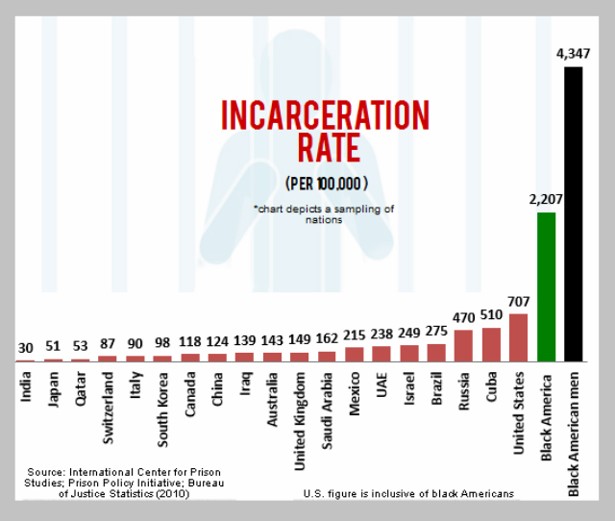
There has never been a break in the idea that Black Lives Do Not Matter. The idea of blackness was founded on it and continues to this day. The history of race is one long saga chronicling the mattering of white lives and the insignificance of black ones. Traditional histories tell us this, telling historical stories only through the eyes of powerful white men. Black kids hear this message loud and clear in history class as well as in real life. In the spring of 2015, I was student teaching in a diverse charter school. During a World History class, a freshman girl, who happened to be black, was looking through the textbook looking for a historical figure to learn about and write about. After a few minutes I walked over to her to see how she was doing, and she said to me, "Mr. H, there ain't no black people in this book." And it was true. In a textbook that claimed to chronicle the history of the whole world, there were barely more than a handful of black characters. White people utterly dominated the pages of the book, telling every black student who read it that they did not matter, and every white student that they did.
We need to say Black Lives Matter rather than All Lives Matter because black lives need to be affirmed. Young black kids have learned that most of the time when white people talk about how all lives matter they don't mean black lives. They've learned to tune out the lies and hypocrisy (but that doesn't mean it doesn't still hurt). They've learned that Black Lives Have Never Mattered. So no matter how genuine you are in your belief that all lives matter, say Black Lives Matter instead because the young black people in this country need to hear it. They need to see it in practice. You're not saying that non-black lives don't matter. You are affirming the lives of a long-mistreated group of valuable human beings and paving the way for a positive change toward actual equality. Stop saying All Lives Matter. White people don't need to hear it. Black Lives Matter.
Friday, September 4, 2015
An Open Letter to Christian Conservatives
Dear Christian conservative,
For too long I have been noticing apparent contradictions between your politics and
the faith you hold dear. And so has the rest of the world. I have a few questions
for you. Please read this letter with an open heart and an open mind. If you
take time to reflect and to really be honest with yourself, maybe you will also
begin to see some of these contradictions and the harm they are causing in our
society.
First question: What is the foundation of your faith? For
me, it is that I am broken but Jesus died and rose again to save me from my
brokenness, and that I should strive to live as much like Jesus as I can. If
that is what you believe, then please take a long, hard look in the mirror. Please
begin to re-examine your political stances and see how well they match up with
the life of Jesus. Take time to seriously ponder the questions in this letter.
I don’t know what your answers will be, but please don’t brush the questions
off. From where I stand, the way you carry out your beliefs in the realm of
politics indicates that the Jesus you know is not the same as the Jesus I know.
I hope that is not true.
The Jesus I know, love, and serve is the most loving,
compassionate, and merciful person ever to walk the earth. When a prostitute was
about to be stoned for her sins, he stepped in and stopped it (John 8:1-11). If
the Jesus you serve acted this way, then why do you support political
candidates and platforms that advocate the death penalty?
Jesus served the
lowest in his society, touching lepers (Matthew 8:1-4; Mark 1:40-45; Luke
5:12-15) and hanging out with fishermen and tax collectors. Jesus loved those
who were at the margins of society. If Jesus did this, then why is it
acceptable to dehumanize innocent people trying to escape hardship? Why is it
okay to deport people who have done nothing wrong? How can you actively support
politics that create an atmosphere that psychologically harms children of
immigrants, both illegal and legal?[1]
How can you accept a culture that labels anyone who looks slightly Middle
Eastern or Arab a terrorist? (Hint: Jesus probably looked more like them than
he looks like you).

Jesus never turned anyone away, deciding to feed large
crowds gathered around him multiple times (Matthew 14:13-21; Mark 6:31-44; Luke
9:10-17; John 6:5-15; Matthew 15:32-16:10; Mark 8:1-9). The early church he founded “sold property and
possessions to give to anyone who had need” (Acts 2:45). Why then do you
support policies that make the rich richer and the poor poorer? Why do you
support the reduction and elimination of programs that help the poor and the
outcasts? Why do you support candidates who fight against the average worker in
favor of the rich business owner? If the answer is that helping the poor is the
job of the church rather than the government, then that requires a secondary
look in the mirror, because we’re doing a pretty crappy job. Even so, it
definitely does not require actively supporting the rich just to have more poor
people to help.
Simply put, Jesus is love. I’m not saying that means that
everything is acceptable and there should never be confrontation, but maybe it’s
time to reevaluate which confrontations you are choosing to have. You claim to
be pro-life, but based on what you fight for, one might be lead to conclude not
just that you believe life begins at conception, but that it ends at birth.
Imagine how much good could be done if everyone who considers themselves
pro-life spent as much energy fighting for the rights of poor people as they do
for the rights of the unborn.
If Jesus told Peter to put down his sword, then why is it so
important to own a gun? If we are supposed to be stewards of God’s Earth, then
why would you support the building of new oil pipelines more than research into
new green technologies? Jesus is not the current Republican presidential
nominee. Please wake up. For too long you have been confusing Jesus with Uncle
Sam, and faith with patriotism.
What does owning a gun have to do with Jesus? What does
building a wall to keep out human beings hoping for a better life have to do
with Jesus? What does imprisoning people at a higher rate than anywhere else in
the world have to do with Jesus? What does fighting wars have to do with Jesus?
Please stop kidnapping my Jesus and shoving Uncle Sam’s hat on his head, a gun
in his hands, and hateful words in his mouth. Stop walking by those in need
like the religious leaders in the parable of the good Samaritan. Many moral
atheists are playing the part of the Samaritan right now. Please dare to have a
bigger vision of life and advocate as strongly for those who are already alive
as you do for those who are unborn. Dare to forge a new path that is connected
not to the Republican Party, but to Jesus. Dare to treat all humans the way you
want to be treated: as a broken, sinful person in need of love and of a savior.
I have a feeling that if every Christian conservative did this, the world would
take notice.
Sincerely,
Steven
Monday, July 27, 2015
The Tragedy of Whiteness
Throughout the entire history of the United States of
America, and even before, to the very first time Europeans set foot on the
continent, its existence has been based on a simple idea: that white people are
superior to all other human beings. This notion arose from ignorance and greed and
continued because of the need to morally justify the institution of slavery. As
Bryan Stevenson puts it, we became a “slave society”: “[T]his narrative of
racial difference has done really destructive things in our society. Lots of
countries had slaves, but they were mostly societies with slaves. We became
something different, we became a slave society. We created a narrative of
racial difference to maintain slavery.” Because nothing was ever done to deal
with the narrative that allowed slavery to remain morally upright in White America,
but only with the institution of slavery itself, Stevenson continues, “I don’t
believe slavery ended in 1865, I believe
it just evolved.”[1]
Whiteness does not
exist. It was simply a social construction built to distinguish those who
were allowed full rights in the world (both in America and in Europe) from
those were not. Yes, people have different color skin, but that is only because
of the region of the world one’s ancestors lived in, not some deep-seated
difference. We are all human, and there are biologically no sub-groups of
humans. The only existing sub-groups are culturally created ones. The social
idea that is whiteness is tragic. It began under tragic circumstances, as those
who created whiteness for themselves did so to assert superiority over other humans.
Like slavery in America, whiteness has evolved, but today is no less tragic
than it was in 1776, or 1860, or 1953, or 1963.[2]
I believe that the great tragedy of whiteness today is
ignorance. Being white means being able to ignore the racial injustices that
continue, and accepting that ignorance. It means learning a whitewashed (pun
intended) version of our nation’s history taught in schools. It means living in
suburbia to avoid having to confront segregation face-to-face. It means the
re-segregation of schools so that white children can learn about the triumph
that was Brown v Board without having
to experience it. It means being able to not be consciously racist and feel “reverse
racism” from affirmative action because of a lack of knowledge of how difficult
it continues to be for non-white Americans to achieve true equality. It means believing
that free-market capitalism is completely meritocratic and therefore cannot be a
remotely racist practice, despite a historic legacy of insuring that it is. It
means believing that the American Dream is alive and well for all, despite the
fact that it was only ever intended for white people.
Not all white people are ignorant of their privilege, but
many are. Due to continued segregation, income inequality, and other injustices
that exist today as a direct result of blatantly racist policies of the past, I
believe that each white person who ignores the present inequality actively
helps to perpetuate it. While this reality is not the fault of individual white
people, it is a reality that has been intentionally created by other white
people. White people have worked extremely hard for centuries to ensure that
any white person who does not consider themselves racist but does not know the
realities of the racial climate actually perpetuates racial injustice. It is
not an accident. White people must fight their own ignorance in order to begin
to deal truthfully with the realities of the United States of America, both
past and present.
I will end on a hopeful note: perhaps change is actually
happening. In an article about a recent poll that showed a substantial drop in
the number of white Americans who believe that race relations are good in
America, author David Graham said this: “This theory—that what’s driving ...
bleak impressions about race relations is whites awakening to realities that
were always extant but had been invisible to them—suggests that the results may
actually be cause for optimism. Actively grappling with racial tensions is
crucial to solving them; ignoring them may obscure the wounds, but it won’t
heal them.”[3] If
this is the case, let us continue to become more aware. If not, let us begin.
[1] https://www.themarshallproject.org/2015/06/24/bryan-stevenson-on-charleston-and-our-real-problem-with-race
Ta-Nehisi Coates also refers to America as a “slave society”
and details what that means to him in this article: http://www.theatlantic.com/personal/archive/2011/09/the-slave-society-defined/244581/
[2]
The founding of our nation, the eve of the Civil War, the year before Brown v Board, and the year before the
landmark civil rights legislation of the 1960s, respectively.
Tuesday, July 21, 2015
The Danger of Islamophobia
Stereotyping, oversimplification, and over-generalization are
dangerous things. When people fall into these traps, the best-case scenario is
that they are simply ignorant and wrong. The worst-case scenario involves much
worse: hate, alienation, and even killing. The mistakes of stereotyping,
oversimplification, and over-generalization have the potential to turn humans
into monsters, and to blind them to reality. In America and other Western
countries, one prevalent, pernicious mistake today is Islamophobia—the fear of
Muslims. To fall into the trap of Islamophobia is to be similar to the likely
reason for the phobia—radical Islamic terrorist groups.
It may seem ridiculous to say that the American public and
the leaders of al-Qaeda and ISIS are similar. It is ridiculous. But I believe that it is nonetheless true. Islamophobia
involves the stereotyping, oversimplification, and over-generalization of
Muslims and even non-Muslim Arabs. It leads people to fear and hate all
Muslims. While Americans have good reason to fear and hate the perpetrators of
such calamities as the 9/11 attacks, they often make the mistake of transferring
that fear and hate to a more widespread group—all 1 billion-plus Muslims in the
world—who had nothing to do with those attacks.
This is the exact same mistake the leaders of extremist
terrorists groups make. These people fear and hate America and Western civilization.
They have good reason to—Western nations have waged numerous wars in the Middle
East for not-so-good reasons. But they make the mistake of transferring that
fear and hate to a more widespread group—all 300 million-plus American citizens—who
had very little or nothing to do with the wars and attacks their nation carried
out.
When Americans judge and discriminate against Muslims, they
are falling into the same trap Osama bin Laden fell into—stereotyping,
oversimplifying, and overgeneralizing based on their justified fear, anger, and
sometimes hate. We must fight to keep from falling victim to Islamophobia. To
fight requires becoming informed about the reasons many Islamic radicals hate
America, and to realize that those are indeed radicals and do not remotely
represent the over 1 billion people who ascribe to more orthodox versions of
Islam. When we let our fear blind us, we are doing the same thing as the people
who caused our fear.
Friday, July 17, 2015
American Exceptionalism Part III: Strive for a Better America
This is the final part of a three-part post. This post begins with a continuation of a non-comprehensive list of American shortcomings.
3. Continued mistreatment of immigrants
3. Continued mistreatment of immigrants
The last two points I will share in this post contain a common
thread: hypocrisy. In this case, the hypocrisy comes as America simultaneously
claims to be a nation of immigrants and mistreats and dehumanizes whoever
happens to be the current wave. In the past this has been variously Eastern
Europeans, Catholics, and East Asians. Now it is Latinos. At almost no point in
the history of the nation that prides itself on being a nation of immigrants
(which it only is because it wiped out nearly the entire native population, as
chronicled in the previous point) has there been a time when the current wave
of immigrants has been welcomed with open arms. This hypocrisy needs to be
addressed because it is very much in existence today.
4. Failed meddlings in other countries’ business
While most Americans are at least aware of the first two
issues, and possibly the third, even if they push them to the corners of their
minds, this is an important issue that I am afraid many people are ignorant of.
The CIA has confirmed involvement in
7 coup d’etats in other countries between 1953 and 1973. Here is a chart and a map chronicling these overthrows:[i]
Year
|
Country
|
Leader
|
How Leader Came to Power
|
Succeeded By
|
1953
|
Iran
|
Mohammed Mosaddegh
|
Democratically elected
|
Dictatorial Shah
|
1954
|
Guatemala
|
Jacobo Arbenz
|
Democratically elected
|
Military junta
|
1960
|
Congo
|
Patrice Lumumba
|
Democratically elected
|
Dictator
|
1961
|
Dominican Republic
|
Rafael Trujillo
|
Military power
|
US-directed elections
|
1963
|
South Vietnam
|
Ngo Dinh Diem
|
Democratically elected
|
Military junta
|
1964
|
Brazil
|
João Goulart
|
Democratically elected
|
Military junta
|
1973
|
Chile
|
Salvador Allende
|
Democratically elected
|
Military dictatorship
|
 |
| The 7 officially confirmed CIA-assisted coups |
This, again, is only the list of countries the CIA has
officially admitted involvement in. This list does not count, for example, the many
failed attempts to assassinate Fidel Castro in Cuba or the (illegal) arming of
the Contras in Nicaragua in the 1980s. Some of these stories, however, are even
more disturbing upon an investigation of the details.
Iran
This story is incredibly important as it explains why Iran
hates us so much, and probably deserves its own blog post considering its
import to current foreign policy. Here are the basics: Mohammed Mosaddegh was
elected Prime Minister of Iran in 1951. At the time, BP (British Petroleum) was
a major presence in Iran (along with other foreign oil companies), drilling Iran’s
oil and making its own profit. Mosaddegh made the mistake of nationalizing Iran’s
oil in order to keep Iran’s wealth in Iran, upon which the British MI6 asked
their American counterparts to get rid of the popular Mosaddegh. They complied,
returning power back to Mohammad Reza Pahlavi, the Shah (monarch). The Shah was
pro-US and was a ruthless dictator to his own people. The US continued to prop
the Shah up until his dictatorial regime came crashing down in the revolution
of 1979 (depicted in the movie Argo).
One of the main reasons Iran hates the US is that the CIA overthrew their
incredibly popular leader and replaced him with a ruthless dictator.
Guatemala
Jacobo Arbenz was elected President of Guatemala after a
revolution that overthrew a US-supported dictator. At the time, United Fruit
Company, an American corporation, owned large portions of Guatemalan land and
underpaid Guatemalan workers, to the point where United Fruit made twice as
much money as the government of Guatemala. Arbenz instituted land reforms,
which hurt United Fruit and benefited Guatemalan businesses, thus prompting
United Fruit to ask the American government to support a coup. Although Arbenz’s
reforms helped most of his own people, the American corporation was successful
in its lobbying and the CIA overthrew Arbenz and installed a military
government instead. Today the United Fruit Company is known as Chiquita
International.
Congo
After being terrorized first by King Leopold II of Belgium from
1885 to 1908, and then by Belgian parliament from 1908 to 1960, Congo finally
overthrew its colonial overlords and gained independence. The Congo Free State,
as it was called under Leopold’s singlehanded rule, could also easily be the
topic of its own blog post, but to make an extremely long and sad story short,
the King of Belgium ran the Congo as his own personal colony for 23 years,
during which he made ridiculous sums of money by using the native population as
slave labor. During those 23 years the population of the territory decreased by
half. When he was finally forced out of power, Leopold had to give it up to the
country of which he was king. Upon gaining independence, the Congolese elected
Patrice Lumumba, an extremely popular Prime Minister. After being rejected by
the American government, Lumumba sought help for his fledgling nation from the
other great world power: the Soviet Union. Because of this, the CIA helped
overthrow Lumumba and eventually installed Joseph Mobutu, a corrupt dictator.[ii]
These are just a few of the times the American government
has stepped in to ostensibly “spread the cause of democracy” and utterly failed
to do so. In addition to the overthrows of multiple popular, democratically
elected officials, almost every venture into the Middle East, driven largely by
the American dependence on oil, has been a complete failure, only increasing by
steps the hatred most in the region feel (I would argue that it is a justified hatred)
for the United States.
I will grant Ben Carson this: if the only events taught in
APUSH were those I just outlined and other similarly terrible things, ISIS
might actually seem like a viable alternative to what could be construed as a
250-year terrorist regime. There needs to be a balance of the good and the bad.
To me the biggest good is this: America is a work in progress. There have been
positive events as well, and I believe those are important to teach, but the
idea that this country can be improved is what makes living here worth it. It
is what makes learning about the negative aspects of America’s history
important. We can avoid repeating
some of the same mistakes, but only if we acknowledge that they happened. America
was not created perfect—the Constitution’s 27 amendments alone can attest to
that. I believe, however, that it is better now than it has been at most points
in our history. Sometimes we take a “one step forward, one step back” approach,
but things are getting better. I think awareness of continued racial strife is
growing, and change follows awareness—not always as fast as we want, but
eventually. If APUSH is taught well, it should leave students not wanting to
join ISIS, but rather desiring to make their country better. I will conclude
with a poignant excerpt from President Obama’s speech on the Edmund Pettus
Bridge in Selma, Alabama, commemorating the 50th anniversary of “Bloody
Sunday”:
What could be more American than what happened in this place?
What could more profoundly vindicate the idea of America than plain and humble
people -- the unsung, the downtrodden, the dreamers not of high station, not
born to wealth or privilege, not of one religious tradition but many -- coming
together to shape their country's course?
What greater expression of faith in the American experiment
than this; what greater form of patriotism is there; than the belief that
America is not yet finished, that we are strong enough to be self-critical,
that each successive generation can look upon our imperfections and decide that
it is in our power to remake this nation to more closely align with our highest
ideals?[iii]
[ii] Barbara
Kingsolver’s novel The Poisonwood Bible
gives an inside look at these events and is an incredibly powerful work of
historical fiction.
[iii]
The complete text of the speech can be found at this link: http://www.huffingtonpost.com/ian-reifowitz/the-selma-speech-obamas-a_b_6846610.html
and this is the video of the speech: https://www.youtube.com/watch?v=7SoG4KZOvRc
Wednesday, July 15, 2015
American Exceptionalism Part II: Without it We'll All Join ISIS
This is the second part in a three-part piece about the idea of American exceptionalism. I will post part III later this week.
I want to come back to the particular narrative, or myth,
that has been particularly strong, and also newsworthy, lately: American
exceptionalism. It is one of those ideas that has become so ingrained that it
has been unwittingly (and occasionally intentionally) perpetuated as propaganda by countless
teachers, politicians, and media personalities. I won’t go into detail here
about where the idea came from, but Foreign
Policy has a nice piece from 2012 recounting the history of both the idea
and the phrase itself, which I would recommend.[i] I
want to briefly discuss the controversy over American exceptionalism brought on
by the new AP US History (APUSH) curriculum, provide some counterexamples to
American exceptionalism, and suggest a more well-rounded view of America.
American exceptionalism says that America is a unique
country and has an obligation to spread its values around the world. It seems
to me that, for most Americans who ascribe to the myth, it includes, in
addition to the mandate to spread its values worldwide, the idea that America
is great because of domestic ideas related to the American Dream as well—as
political sociologist Seymour Martin Lipset says, “liberty, egalitarianism,
individualism, populism, and laissez faire.”[ii] College
Board recently changed its curriculum framework for APUSH to one that led
students to question the American exceptionalism narrative more than the
previous framework had. The new framework is based on themes, which are,
according to the College Board website, Identity; Work, Exchange, and
Technology; Peopling; Politics and Power; America in the World; Environment and
Geography—Physical and Human; and Ideas, Beliefs, and Culture.[iii]
Dr. Ben Carson, now a Republican Presidential candidate, said that this
framework of themes would cause “most people when they finish that course, [to]
be ready to sign up for ISIS.”[iv]
First of all, the course is only a framework and it is up to
individual teachers to flesh out that framework. Second, the accusation brought
by Carson, as well as the Republican National Committee, is that the course
emphasizes the negative aspects of American history while skimming over the
positive ones. If there are enough parts of American history that are negative enough
that any APUSH student would actually
want to sign up for ISIS upon completing the class, then I think that rather
than condemn the class designers, we should take a long hard look in our
country’s historical mirror. In addition to this, if focusing on solely the
negative aspects of American history is unacceptable, then surely focusing
solely on the positives would be equally egregious, right?
I think Dr. Carson’s
words point out a gaping hole in the American mentality. If we are unable to
examine our past ills as a country, how are we going to learn from our
mistakes? Dr. Carson continued in the same speech, saying, “We have got to stop
this silliness. We have to stop crucifying ourselves. Have we made mistakes as
a nation? Of course we have. Why? Because we are people and all people make
mistakes.” I agree that people make mistakes, but I also believe that ignoring
those mistakes would be even worse than making them in the first place.
I think that in light of this fear of self-examination,
Americans need to confront the fear by acknowledging the country’s past
mistakes in order to learn from them. Here are some that I think are especially
important in consideration of their affect on the world now:
1. Treatment of Native Americans
 |
| Below its more famous sections, the Declaration of Independence refers to Native Americans as "the merciless Indian Savages." Photo credit to Mark Charles at wirelesshogan.com |
Christopher Columbus did not discover America. Millions of
people already lived there. While the United States is not alone in the
mistreatment of Native Americans, it is still a dark mark in the history of the
country that cannot be pushed aside (but too often is). In the 1820s Andrew
Jackson defied the Supreme Court and forced multiple tribes off their land in
the southeast and forced them to march to what is now Oklahoma, resulting in
thousands of deaths along the way. Long before the not-so-subtly named Indian
Removal Act that authorized the Trail of Tears, however, the founding fathers
wrote a document that labeled these people as “merciless Indian savages.” Earlier
in this same document is found the much more well-known line, “all men are
created equal.” Even after the Trail of Tears the nation was not done
mistreating those who had occupied their land for centuries: throughout the 19th
century, the United States army carried out a genocide of native tribes in the
Great Plains. The few times where this genocide faltered due to opposition by
those who, understandably, did not want to be killed, were given romanticized names
like “Custer’s Last Stand.” Associated with this series of battles meant to
steal the natives’ land was what is known as the Trail of Broken Treaties.
Lakota chief Red Cloud put it well: “They made us many promises, more than I
can remember, but they kept only one; they promised to take our land, and they
did.”
2. Treatment of African Americans

American failures in this area are innumerable. Beginning
with slavery and continuing through the Jim Crow south, white Americans have,
to this day, maintained an ideological, economic, and social superiority to
non-white Americans, and specifically African Americans. The gradual gains
African Americans have been able to make in the face of white opposition should
be praised, but in most cases the changes achieved were quite small compared to
what was needed, and the changes were always too late. We cannot gloss over the
historical mistreatment of African Americans because the mistreatment and
inequality continues today. Despite Brown
v Board of Education in 1954 (61 years ago!), schools today are still incredibly
segregated. There is still an enormous income gap, and segregation is alive and
well in American cities. In order to continue pressing for change and equality,
the past and present sins of white America must be addressed.
In Part III I will explore two more parts of American
history and conclude with my idea of what American exceptionalism should be.
[ii] I
found this quoted in a Washington Post article about American Exceptionalism: http://www.washingtonpost.com/blogs/the-fix/wp/2013/09/12/american-exceptionalism-explained
[iii]
For more details on what College Board means by these themes, see the course
framework here: http://media.collegeboard.com/digitalServices/pdf/ap/ap-us-history-course-and-exam-description.pdf
The description of the themes begins on page 20.
Subscribe to:
Posts (Atom)