Early white American settlers began using slaves long before there was such a thing as the "United States." Slavery made economic sense because you don't have to pay slaves, therefore increasing profits. Slavery was not a new idea, but the justification for it was new. Most other societies with slavery up to that point simply saw it as a power balance. People with power enslaved those without it. Americans, however, believed strongly in the ideas of freedom and human rights, ideas with which slavery is incompatible. To reconcile slavery with freedom, they (along with other Europeans) invented the idea of race--that there were different "races" of people with inherent differences between them. (While Wikipedia is not always the best source, the Wikipedia page on Scientific Racism has a good overview of this idea and the thinkers who propagated it.)
 |
| A diagram showing how Negroes fell somewhere between Greeks and chimpanzees |
Slavery was based on the idea that black lives do not matter. I am going to skip a large chunk of American history, to the period following the Civil War, when slavery was abolished. (The Civil War, by the way, was most assuredly about slavery. If you believe otherwise, please read the article linked on the right sidebar.) By the time slavery was formally ended in the United States, the idea of race had become completely ingrained in society. As Michelle Alexander puts it in her book, The New Jim Crow, "The history of racial caste in America would end with the Civil War if the idea of race and racial difference had died when the institution of slavery was put to rest.... Indeed, the notion of racial difference--specifically the notion of white supremacy--proved far more durable than the institution that gave birth to it." White people still largely believed the lies they had been told about race, and strove to find a new way keep the separation that slavery had created between whites and blacks.
The new system became known as "Jim Crow." In this system, many states passed laws (examples here, here, and here) that attempted to return black Americans to as close to a state of slavery as they could manage. On top of this, the Ku Klux Klan terrorized black communities, lynching and threatening black people for simply attempting to live their lives. Black Americans were severely limited in their education, employment opportunities, civil liberties, and just about everything else. Jim Crow-era America was a strong continuation of the idea that Black Lives Do Not Matter. I could go on about the details and horrors of Jim Crow America, but there is unfortunately not enough room for it in a blog post. I would suggest reading the first chapter of The New Jim Crow, which does an excellent job of laying out the history of oppression. (Seriously, read it. The link to the Amazon page is above.)
White Americans love to believe that racism ended in America around the time of the Civil Rights movement in the 1960s. Unfortunately, that is neither realistic nor correct. Black Americans have had to endure racist housing policies that forced them to live in areas with low property value, robbing from them one of the major sources of wealth for white families: appreciating real estate values. This was part of a cycle that continues today: white families pass down property that increases the wealth of the next generation, while black families lose wealth through real estate. Housing discrimination ties directly into educational discrimination. In 1954, the Supreme Court ruled that "separate but equal" facilities were unconstitutional, leading to the (painfully slow) integration of America's schools. Unfortunately, soon after the integration of schools, white Americans fled to the suburbs, effectively re-segregating the schools. Because black families were not allowed housing in many suburban neighborhoods, even well-off black families could not move to districts that were better-financed (quality of education has nothing to do with the color of students' skin, but it has everything to do with the property values of homes in the school district). Discriminatory housing policies directly led to a vast educational gap, which further exacerbates economic inequality.
In addition to these discriminatory policies, the new War on Drugs was both explicitly and implicitly racist. In the post-Civil Rights era, it was no longer politically viable to use explicitly racist language, but white politicians found a way around this. The War on Drugs used language that was hard to argue against (safe streets, protecting children, tough on crime) to validate awful policies. Young black men began to be arrested far out of proportion for nonviolent drug offenses. Laws dictating minimum sentences were disproportionate for crack cocaine versus powder cocaine--the main difference between the two being that powder cocaine was more expensive and more often used by rich white people. Simply put, powder cocaine was the white person's cocaine, and crack was the black person's cocaine. (Obviously it is not this simple, but black users used crack at a higher rate than white users did, and vice versa for powder). It took 100 times as much powder cocaine by weight to carry the same minimum sentence as did crack. In addition, there was disproportionate police attention in poor, black neighborhoods. Even without gross sentencing disparities, police have been arresting black people at a rate completely disproportionate to other races from the inception of the drug war to the present day. Take, for example, marijuana use versus marijuana arrests:


The racism here is quite clear, and black people know it. Police disproportionately target black neighborhoods and people, whether white people want to admit it or not. While white kids are taught to trust the cops and that they are "good guys" and there to help, black kids, especially young boys, are given "the talk" (if you only watch one TED talk, let it be this one) about being careful around cops (and your friendly neighborhood vigilante) because they are dangerous. Black people, and specifically black men, are jailed at an unconscionable rate, continuing the idea that Black Lives Do Not Matter. Try to wrap your mind around this graph:
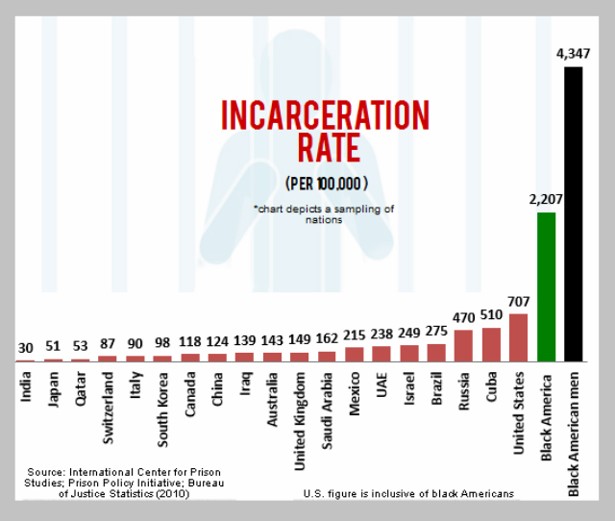
There has never been a break in the idea that Black Lives Do Not Matter. The idea of blackness was founded on it and continues to this day. The history of race is one long saga chronicling the mattering of white lives and the insignificance of black ones. Traditional histories tell us this, telling historical stories only through the eyes of powerful white men. Black kids hear this message loud and clear in history class as well as in real life. In the spring of 2015, I was student teaching in a diverse charter school. During a World History class, a freshman girl, who happened to be black, was looking through the textbook looking for a historical figure to learn about and write about. After a few minutes I walked over to her to see how she was doing, and she said to me, "Mr. H, there ain't no black people in this book." And it was true. In a textbook that claimed to chronicle the history of the whole world, there were barely more than a handful of black characters. White people utterly dominated the pages of the book, telling every black student who read it that they did not matter, and every white student that they did.
We need to say Black Lives Matter rather than All Lives Matter because black lives need to be affirmed. Young black kids have learned that most of the time when white people talk about how all lives matter they don't mean black lives. They've learned to tune out the lies and hypocrisy (but that doesn't mean it doesn't still hurt). They've learned that Black Lives Have Never Mattered. So no matter how genuine you are in your belief that all lives matter, say Black Lives Matter instead because the young black people in this country need to hear it. They need to see it in practice. You're not saying that non-black lives don't matter. You are affirming the lives of a long-mistreated group of valuable human beings and paving the way for a positive change toward actual equality. Stop saying All Lives Matter. White people don't need to hear it. Black Lives Matter.

No comments:
Post a Comment